

The US Needs a Law to Stop Algorithms From Being Racist Because Silicon Valley Won’t


A group of Democratic legislators reintroduced an AI civil rights act aimed at eliminating AI discrimination.
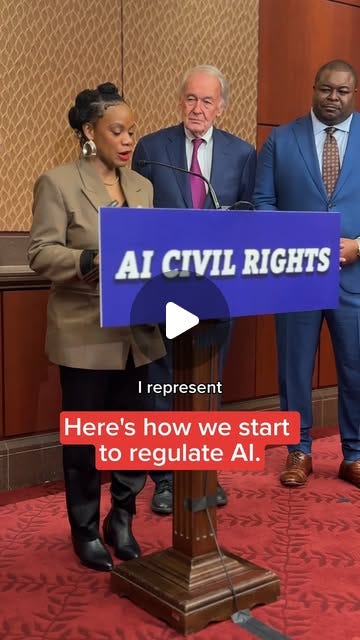
Announced late last week by Congresswoman Ayanna Pressley, the law, titled the “Artificial Intelligence (AI) Civil Rights Act,” will focus on preventing companies from using AI algorithms that are founded on biases and discrimination. By doing so, the act will ensure that any AI-driven decisions that affect Americans are made with technology that has been properly tested. It will also verify which algorithms are being used to make these decisions and will increase transparency.
The act is being supported by a number of politicians, including Representative Yvette Clarke, Senator Edward J. Markey, Representative Pramila Jayapal and Representative Summer Lee. Additional support has been provided by the National Urban League, President and CEO of The Leadership Conference on Civil and Human Rights Maya Wiley, the AFL-CIO, the Lawyers Committee for Civil Rights Under Law and the Center for AI and Digital Policy.
“As AI innovation grows, it is incumbent on us all to prioritize the safety, rights, and opportunity of all people—especially the Black, Brown, and marginalized communities who disproportionately bear the burden of biased and discriminatory systems,” said Rep. Pressley in a statement. “We cannot allow AI to be the latest chapter in America’s history of exploiting marginalized people. That is why the AI Civil Rights Act is necessary—to invest in an approach rooted in equity that safeguards all of our civil rights and liberties.”
The reintroduction of the act comes months after the approval of a California law that expanded anti-discrimination laws to include AI. Effective Oct. 1, the new regulations protect employees from discrimination arising from automated-decision systems.
The new amendments ensure that, if any applicants or employees are discriminated against by an automated-decision system on account of gender, race or disability, it would be a violation of California law.
Previous research released by Brookings found that, overall, in a simulation used to mimic real-world applications of the AI-algorithms used, racial bias is pronounced in AI systems used during hiring practices.
According to the report, white-associated names were selected in 85.1% of the simulations run, while Black-associated names were selected in just 8.6%. Black men were amongst those most disadvantaged, as their resumes were selected 0% of the time when compared to the resumes with white-associated names.
With the AI Civil Rights Act, the law would protect employees from hiring discrimination alongside other decision-making opportunities, such as who is eligible for a loan or parole.
“The AI Civil Rights Act also brings clarity to the long-debated question of who should be held accountable for the civil-rights harms caused by algorithmic systems,” said members of the ACLU in a press release. “If passed, the AI Civil Rights Act will make developers and deployers the parties responsible for taking reasonable steps to ensure their AI models do not violate our civil rights. The accountability mechanisms in the act are pivotal to empowering individuals against algorithmic harm while ensuring that AI developers and deployers understand that it is their duty to have low risk models.”