

South Africa’s Crackdown on a US Refugee Center Collides With Trump’s ‘White Genocide’ Claims

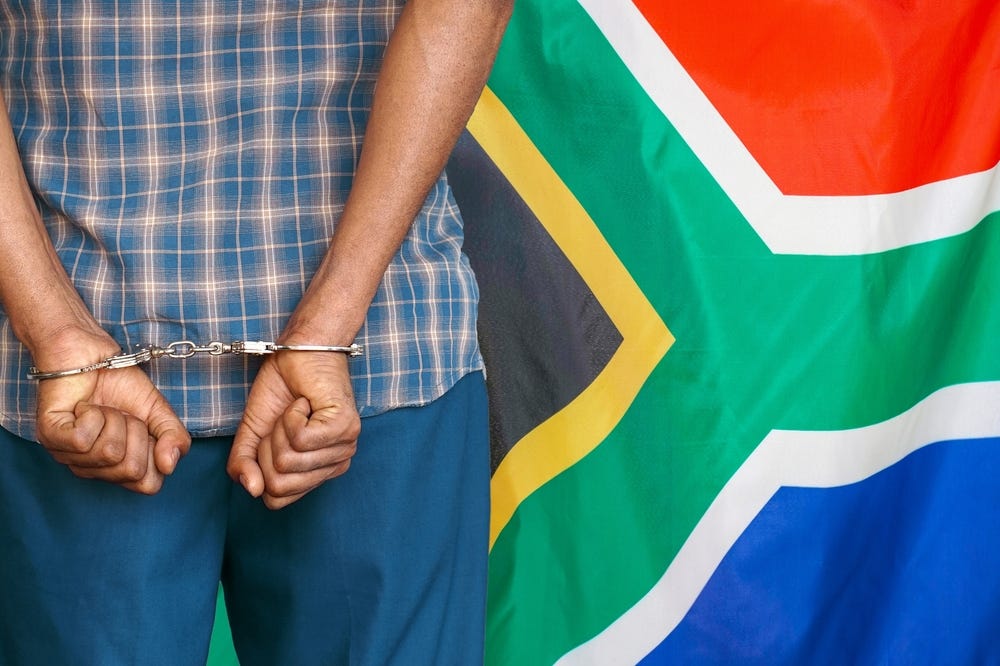
South African officials said that they arrested seven Kenyan nationals who were working illegally at a U.S. refugee program application center.
Announced yesterday by the South African Home Affairs Ministry, the officials said that two other U.S. refugee officers were also briefly detained during a raid on Tuesday. The seven Kenyan nationals are set to be deported and denied entry to the country for five years.
They reportedly entered South Africa on tourist visas, but remained in the country to work at the center without proper work visas. They were previously denied work visas when they applied.
All processing of applications by white South Africans for the U.S. refugee program is being handled by RSC Africa, a center operated by Church World Service. The Church World Service is an organization based in the U.S. that works closely with the U.S. Refugee Admissions Program.
In a statement, the South African Government announced that it had already contacted the U.S. and Kenya.
“The presence of foreign officials apparently coordinating with undocumented workers naturally raises serious questions about intent and diplomatic protocol,” said the officials.
In response, a spokesperson for the U.S. State Department claimed that the raid was “unacceptable” and that they expected “full cooperation and accountability” as well as “immediate clarification.”
The latest development is expected to increase tensions between South Africa and the US. Although South African officials have attempted to mend their relationship with the U.S., the Trump administration continues to claim that the country’s government is committing genocide against the white minority.
President Trump has repeatedly claimed that there is a “white genocide” against Afrikaners, peddling images, videos and news reports of them allegedly under attack.
Per police data released, however, there have been approximately six murders on South African farms from January to March this year and most victims in the country are Black. Of the six murders, five victims were Black and only one was white.
In a statement, the police minister also claimed that these murders have been “distorted and reported in an unbalanced way,” highlighting that statistically African people have been most impacted by farm murders. The police minister also rejected the idea of “land grabbing,” although he did admit there have been cases of land invasions. According to the officials, the land invasions have been a final act of desperation from African citizens who have had their land taken from them.
Some Afrikaners themselves have also denied that there is a genocide against them. A public petition has been circulated by Afrikaner journalists, professionals and other officials, rejecting claims that they are victims of a genocide and denouncing being used as political “pawns.” The group also highlighted that the South Africans in general are faced with a variety of issues and that Afrikaners have a history of apartheid they are still reckoning with.
Originally known as Boers, Afrikaners came from a line of Dutch, German, and French colonists who arrived in Africa in the 17th century. As their population expanded, they moved further into the country, claiming land to farm. Fought in three phases, the Boer War, lasting from 1899 to 1902, was a later conflict between the Boers and British colonists from the Cape Colony.
Although the result was a victory for the British, the Boers remained the white majority and obtained governmental control. By 1948, this government implemented apartheid. Made possible through previous acts such as the 1913 Land Act, which forced Black Africans into reserves and made sharecropping work illegal for them, apartheid became law in 1950 with the passage of the Population Registration Act of 1950. The act promptly divided all South Africans by race.
Other land acts also divided the nation by giving over 80% of South African land to the white minority and requiring Black South Africans to carry documents to prove that they are “allowed” into “restricted areas.” Along with creating separate facilities, Black South Africans were also denied the chance to run for positions in the national government.
They were further segregated into 10 Bantu homelands as a way for the government to claim that there was no longer a Black majority. Over 3.5 million Black South Africans were displaced and forced into homelessness and poverty during this time.
Although resistance began in 1952, the end of apartheid officially came in the 1990s. On Feb. 12, 1990, anti-apartheid activist Nelson Mandela was freed from imprisonment. That same year, negotiations to end apartheid began as the ANC was no longer banned by the South African president, F.W. de Klerk.
By 1994, apartheid ended as a new democratic government was instituted, and Mandela was elected as the first president of South Africa. Throughout this four-year period, approximately 14,000 South Africans died as a result of political violence, marking the most violent period in the country’s history.
Despite the end of apartheid, Black South Africans still own just a fraction of farmland across the nation. Earlier this year, President Cyril Ramaphosa signed a bill into law addressing land restitution, allowing the government to expropriate land without payment.
In response, Trump threatened to cut off aid to South Africa in a Truth Social post. In late November, he also announced that South Africa will not be invited to the 2026 Group of 20 summit.
This year, the summit in Johannesburg was boycotted by the United States due to disagreements with South Africa's agenda.