

Houston, Don’t You Know We’ve Always Had a Problem?
They could not get a shot off on their final possession, with the 2025 NCAA Championship hanging in the balance. Looking back over the University of Houston’s history, one wonders whether the Cougars are snakebitten when the task is to execute in the eleventh hour.
Many teams in college basketball can only daydream of hoisting the coveted national championship trophy after the NCAA Final Four. It is a title garnered through earnest navigation of the March Madness bracketed labyrinth. Either win or go home. Consolation games are passé, no longer used (since 1981) to determine third and fourth place. Ballots from sports writers and subjective and ambiguous rankings are rendered null and void. At the season’s close–justifiably so–the last team standing at the final buzzer is the irrefutable victor.
At the University of Houston, despite a platoon that had been powerful over this past season (35-5), once again, the Cougars fell short. They have been bridesmaids a few times, coming up empty in March Madness despite seven Final Four appearances. They ascended to prominence in each instance, leaving multitudes wondering how they had not walked away in triumph. No matter who takes the reins of head coach, a tantamount fate emerges. From Hall of Famer Guy Lewis to current head coach Kelvin Sampson, a championship for the Houston Cougars, seemingly nanoseconds away sometimes, has not come to fruition.
THE BIG “E” & THE “DUCK”
In the mid-60s, head coach Guy Lewis atomized the color barrier at the University of Houston. With intrepid moxie, he journeyed into Louisiana and recruited two of the finest prep hoopsters in the nation. Those players were “The Big E,” Elvin Hayes (Rayville-E.D. Britton), and Don “Duck” Chaney (Baton Rouge-McKinley). Both were highly prized recruits who would later become very successful professionals. Although an excellent all-around player, the 6’9″, 235-pound Hayes was more renowned for his scoring ability; he was also proficient at rebounding and blocking shots. Chaney, at 6’5″, 215 pounds, and capable of filling the nets, was better known as a hounding and smothering defensive specialist.
The former–Hayes–surmounted a childhood speech impediment, majored in speech, and often chattered to his counterparts on the court and via the press. On the floor, both were very physical, never dirty. Off the hardwood, they were resilient enough to deal with the perils of the ’60s Jim Crow South.
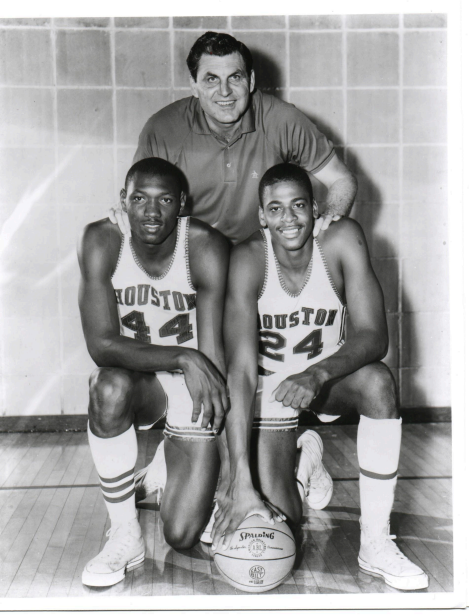
“[There] were still obstacles. ‘There were racially insensitive comments towards Don and me that continued at gyms the Cougars played in [on the road], just like they did in high school around the state of Louisiana.’ Hayes also recalled how his parents couldn’t visit with him at a hotel during a road trip to New Orleans.” [1]
“My parents drove down and came to see us play in New Orleans,” Hayes stated. “We had to get approval to stay in the hotel (with the team), but my parents and relatives came down, and they could not come inside the hotel to visit. We had to go outside the hotel to see them and stand outside in the rain.” [1]
Well in advance of the 1979 Magic v. Bird epic showdown, there was a trilogy of Lew Alcindor v. Elvin Hayes.
Their much-anticipated initial confrontation occurred at the 1967 NCAA Final Four in Louisville, Kentucky. UCLA won 73-58, and the two giants (both of whom would become first-team All-Americans and first-overall NBA draft picks [1968 and 1969]) appeared amicable before and after the matchup. However, the “Bayou State” native sang a different tune when queried about Alcindor’s prowess in front of journalists. “Hayes [contended] afterward that his teammates had ‘choked’ and that he had found Alcindor sadly lacking. Speaking evenly and with apparent conviction, Hayes said: ‘He’s not aggressive enough on the boards, particularly on offense. Defensively, he just stands around. He’s not at all, you know, all they really put him up to be.” [2]
During a face-to-face meeting post-game, Hayes and Alcindor exchanged brief critiques after hanging out and visiting a record store. According to sportswriter Frank Deford, “The next afternoon, Alcindor came to Hayes’s hotel room, and they wandered off down 4th Street (Louisville), looking for a pair of sunglasses for Lew. Easter shoppers—a large number wearing frightful pink hair curlers that set back the image of Kentucky womanhood several years—had the nerve to stare to such an extent that the two big men settled for a visit to a record shop, where each bought to his taste. Alcindor: Cannonball Adderley; Hayes: the Supremes. Then they returned to Hayes’s room, where the talk turned back to basketball. Alcindor, absolutely unmoved by his friend’s public criticism, promised to follow Hayes’s advice and build himself up with weights. Lew, tacitly acknowledging the wisdom of Guy Lewis’s game plan, encouraged Hayes to go to the basket even more.” [2]
Elvin enclasped the saturation of the limelight, while Lew Alcindor (not yet Kareem Abdul-Jabbar), keenly aware of his worth, strategically avoided it. There was a surplus of ink/press for Elvin, which was congruent with his personality. In contrast, Alcindor’s approach (even into the pros) was “[to] get my 25 or 30 and let my teammates score the rest.” [3] Like others, Hayes matured later. Fond of prolific numbers, especially his points (chiefly) and rebounds, he was known as a shoot-first, ask-questions-later guy. For example, as a rookie with the San Diego Rockets, Hayes, who led the league in scoring that season, once infuriated his teammates by receiving the ball 29 times in the post in one contest and shooting it 28 times!
Round one had gone to UCLA; nevertheless, Hayes (25 points and 24 rebounds) had statistically gotten the better of Alcindor (19 points and 20 rebounds) and let the world know about it. Hayes stated, “I beat him one-on-one tonight. I was pleased with myself.” [4]
There’s a time-honored saying about winning battles and losing wars. While Hayes reveled in his press clippings and box scores, UCLA “survived and advanced” to crush Dayton for its first of three consecutive NCAA titles. Houston defeated North Carolina in the consolation game, 84-62, thus taking the prize money for a third-place finish.
GAME OF THE CENTURY
The nationally televised rematch on January 20, 1968, is well-chronicled. Both entered the mid-season contest undefeated: top-ranked UCLA and number 2 Houston (in the Associated Press poll). No title was on the line, only bragging rights for the regular season.
For the UCLA Bruins, it was a painful, prickling loss. For Lew Alcindor, it was a bedeviling nightmare. The 7’2” All-American sustained a corneal scratch against the University of California leading up to the contest, requiring him to miss the next two games. He had the option to sit this out, but played despite having vertical double vision. The junior stalwart shot a dismal 4/18 from the field for 15 points. In summary, he visualized two hoops and two Hayes that evening.
It was the only college game in which Lew would shoot less than 50%.

In stark contrast, Hayes incinerated the nets, shooting 17/25 for 39 points (including 29 by halftime and two free throws late in the game to lock up the victory). Houston won the titanic battle by a score of 71-69. A portion of 52,000 fans flooded the Astrodome floor, toting Hayes off the court as a hero. Immediately, the Cougars took the number one ranking from UCLA after breaking their 47-game win streak. Hayes continued to squawk incessantly about his vanquished rival. Alcindor—embarrassed and incensed—took a copy of a Sports Illustrated cover with the caption “BIG EEEE OVER BIG LEW”, which featured Hayes shooting over him during the two-point win, and posted it in his locker for the remainder of the season.
Based on his performance that night, Hayes all but secured the 1968 College Player of the Year award, and Guy Lewis was named Coach of the Year. The Houston big man had spectacular numbers, averaging 36.8 points and 18.9 rebounds. Nevertheless, bias within the sports pages was not challenging to decipher. Read any textbook, periodical, or publication on the Black athlete in the 60s and 70s, and commonly, the following descriptive words will appear: surly (menacing or arrogant), uppity (haughty or high-and-mighty), and moody (a head case warranting certified DSM psychiatric analysis). Elvin was brash and complicated but generally well-liked as a collegian (later despised and deemed self-centered by his second pro season). Alcindor, outspoken, active and unapologetically Black during those tempestuous times, was dubbed with all three descriptors and worse.
Post-season awards, however, were little consolation for what was looming on the horizon. Each team ran the table and stormed into the NCAA tournament that year. Inevitably, they met again at the Los Angeles Sports Arena in the 1968 NCAA semifinals.
Hayes reflected on his credo decades later: “My plan was to get Alcindor [Kareem] in a one-on-one situation. His star was so high and bright in the sky that he was held up as unbeatable. He was all-everything, and I wanted to take his star down and put mine up there. Before that game, we were friends, but after that [1968] Houston game, we never really talked again. We could play on the same [NBA] All-Star team and never talk to each other. When I played with Washington, and he played with L.A., I never shook his hand. That game created such a competitive nature.” [5]
Legendary Moments: Houston Men’s Basketball – Game of the Century (Jan. 20, …
Elvin continued his sentiments on whether Alcindor’s eye lesion was a factor on that fateful evening at the Astrodome. Neither he nor the other Houston players believed he was seriously hurt, even though the injury was legitimate. Hayes said, “Every time Alcindor went up to shoot, [6’9” forward] Ken Spain and I were coming over the top of the key and blocking his shot. Maybe that [impacted] his eye, you know? I’m glad he played, and I’m glad they gave him an excuse, but we still won the basketball game.” [5]
NEVER POKE THE BRUINS
The moment of verity came not in the Astrodome but in the rubber match in Los Angeles at the 1968 Final Four. Attrition and ailments were not an element in the equation. True to form, Elvin insisted, “[UCLA] couldn’t play us as close now as they did then. If we played ‘em again, we’d beat ‘em worse, and it wouldn’t matter if it were on their own floor.” [2]
Metaphorically, the “Big E” was endorsing checks that his ass could not cash. The surcharge for him and the Houston Cougars was exorbitant, and payday would come on March 22, 1968. Utilizing a diamond-and-one defense with one player (6’5” forward Lynn Shackelford) face-guarding Hayes, the UCLA Bruins gave them a thorough lacing, winning in a rout, 101-69. At one point, the Bruins led by 44 points. Elvin could only manage a paltry 10 points on 3/10 shooting. Not a single Houston starter shot better than 39% from the field. Conversely, for the defending champs, balanced scoring was Coach John Wooden’s order for the day, which worked perfectly. UCLA got 19 points each from Alcindor, Mike Lynn and Lucius Allen (who would win an NBA title alongside Alcindor in 1971 with Milwaukee), along with 17 points from Lynn Shackelford, and 14 points from Mike Warren (who by 1981 was starring in Hill Street Blues).
Next, UCLA defeated North Carolina 78-55 for its second consecutive NCAA title. Alcindor had set the tone as the focal point of the milieu in which Bruins basketball thrived. Houston also fell short in the national third-place final, losing to Ohio State 89-85. Hayes closed his college career with a 34-point/16-rebound performance.
Former Houston guard Chaney reflected on the loss decades later. “An overlooked fact, in Chaney’s eyes, was that Houston was without starting guard George Reynolds, a transfer ruled ineligible before the season’s final game because of his junior college academic record. ‘Someone had done some research–I think it might have been from [the UCLA] side,’ Chaney said.” Besides that, the Cougars had gone Hollywood. Hayes and Theodis Lee appeared on The Joey Bishop Show days before the game, and center Ken Spain went on The Dating Game as the players soaked up the California scene. ‘That really hurt us,’ Chaney said. ‘We were a team that was very pleased with the year we had. We got carried away and lost our focus. We learned a big lesson. I did, and I know Elvin did. We got full of ourselves.” [6]
OLLIE, OTIS & THAT ’70s SHOW
After Hayes and Chaney’s departure, the Cougars remained competitive. Unfortunately, it would be long before the program returned to being a legitimate contender. Still, loads of talent came through the “H-Town” institution in the late ’60s and throughout the ’70s. One was a junior college transfer, Rucker Park legend Ollie Taylor. An excellent all-around player, he was also well known for his 46-inch vertical leap, which he utilized to posterize countless foes.
Ollie was not a high school star at the well-populated (10,000 students) DeWitt Clinton in the Bronx (NYC). Making the team—and sitting on the bench—was an honor. One of the players seated beside him, collecting splinters, was a future NBA Hall of Famer named Nate “Tiny” Archibald. Ollie scored 4 points in high school but took full advantage of his next opportunity.
“He began his college career at San Jacinto Junior College, where he set National Junior College Athletic Association (NJCAA) records for points in a season (1409 in 1967-68; 30.7 ppg) and a career (2456; 26.2 ppg). He led San Jacinto to a 44-2 record and a national title in 1967-68, setting the school’s single-game scoring record that season with a 53-point outburst. Taylor was inducted into the NJCAA Hall of Fame in 1994 (other members include Bob McAdoo, Spencer Haywood, Artis Gilmore, Larry Johnson, and Shawn Marion). Taylor spent the last two seasons of his college career at the University of Houston. In 1969-70, his senior season, Taylor averaged 24.4 ppg and 11.5 rebounds as the Cougars went 25-5 and made it to the Sweet 16. Taylor was named a Helms Foundation All-American. Taylor averaged 22.0 ppg and 10.3 rpg in 56 games at Houston.” [7]

Ollie Taylor transitioned one day before this year’s championship game between Houston and the University of Florida. He succumbed to illness and was laid to rest in Pearland, Texas.
Former coach Guy Lewis, speaking years ago, told Sporting News, “Ollie Taylor out-jumped Alcindor (UCLA’s Kareem Abdul-Jabbar) at the start of the (1969) game. He was 6-2 and played the post for me. One of the best post players I ever had.” That is high praise when one considers that Lewis coached Hall of Famers Elvin Hayes, Hakeem Olajuwon, and Clyde Drexler (a college forward who shifted to guard in the NBA). Taylor was drafted by the Cleveland Cavaliers but elected to sign with his hometown New York Nets of the ABA.” [7]
From the 1970-71 season through 1979-80, the Cougars won over 20 games five times and made four NCAA tournament appearances. During the 1976-77 season, Houston went 29-8 (placing second to Arkansas in the Southwest Conference) and was the runner-up to St. Bonaventure in the NIT (National Invitational Tournament).
Other notable Cougars during the 1970s interlude included Dwight Davis, Lou Dunbar, Dwight Jones, and the backcourt phenom Otis Birdsong.
1. Dwight Davis starred at Worthing High in Houston before flourishing as a power forward at the University of Houston. The Cleveland Cavs selected Davis as a first-round pick (3rd overall), and he made the 1972-73 NBA All-Rookie Team.
2. “Sweet” Lou Dunbar: another wonder from Louisiana (their first Black player to be named Mr. Basketball), he arrived in Texas and put up prolific scoring totals, averaging over 22 points per game for his Cougar career. Chosen by the Philadelphia 76ers but played overseas and eventually became a much-celebrated Harlem Globetrotter (along with former Houston star Theodis Lee).
3. Dwight Jones: Another native of Houston (Wheatley High), his hoop skills at the center position led him to the university, the ’72 Olympics (as their leading scorer, he was allegedly provoked into an altercation and subsequent ejection in the final vs. USSR), a first-round NBA draft pick (Atlanta), and a cameo on Soul Train as a member of the Lakers during his ten-year career.
4. Otis Birdsong, arguably the best of the 1970s bunch, was recruited out of Florida. He starred at Houston as a shooting guard, averaging 30 points per contest as a senior and becoming a first-team All-American. In his 12-season career in the NBA, Otis became a four-time All-Star and an All-Pro (1981).
ALTITUDES, OXYGEN & FOUL TROUBLES
At the onset of the 1980s, the University of Houston was constructing a juggernaut. Spearheaded by high-scoring guard Rob Williams, a developing Clyde Drexler, Larry Micheaux, and Michael Young, the Cougars went 25-8, making their way to the 1982 Final Four before falling to the eventual champion, North Carolina, in the semi-finals. A freshman 7-footer from Nigeria named Akeem Olajuwon was slowly marinating on the bench, on the brink of luminary strata.

That era depicted a vindication of sorts for the 20-year-old Drexler. His signing led to many boosters voicing their displeasure and denouncing his recruitment in 1980. To detractors, the local standout (Sterling High) was considered a decent player but not talented enough to play at the University of Houston. That notion would become erroneous because of the 6’7” jheri-cured newcomer’s performance. By 1983, Clyde “The Glide” was selected as the Southwest Conference Player of the Year and a consensus All-American.
That 1982-83 season put the high-flying Cougars, now known as Phi Slama Jama, on an even loftier echelon. After going 31-2 overall (16-0 in the Southwest Conference), they entered the NCAA title game as immeasurable favorites against the underdog yet dangerous N.C. State Wolfpack (unranked before the NCAA Tournament, with a 17-10 record), postseason victors in the ACC bonanza. The Final Four was held in Albuquerque, New Mexico; for some participants, the high altitude (10,600 feet in the Sandia Mountains) would become a factor.
Unfortunately for Houston, complete with all the spellbinding dunks and spectacular aerial maneuvers, the bottom line is that when the rubber hits the road, each one is only worth two points. Rim-rattling “flushes,” while electrifying, are tantamount to a layup, a jumper from the elbow or a putback from within the paint.

Houston, predicted to roll over “The Pack” fluently, aptly found themselves in a fracas. It’s no fun when the rabbit has the gun. State, spearheaded by guards Sidney Lowe and Dereck Whittenburg, who had played together since high school (DeMatha-Hyattsville, MD) and had physiques resembling safeties (strong and free), paced the underdogs to a 33-25 halftime lead.
Olajuwon catalyzed the Cougars with 20 points, 18 rebounds, and seven blocked shots. Teammate Clyde Drexler, however, was a nonentity. The “Glide” finished with 4 points and four personal fouls (the last one controversial before halftime) in 25 minutes of play. The terrain and elevation of the venue in the mountains had taken its toll on Akeem; he was fatigued and required oxygen on the bench. As a result, Coach Lewis made an
ill-fated move: after making a 17-2 run and going up by seven, he slowed the Cougar offense down to “work” the clock. With their newfound penchant for pulling off “cardiac” comebacks, NC State snipped away at the lead.
The thriller came down to the closing seconds, with the score all square at 52. The Wolfpack had possession, and Coach Jim Valvano drew up a play for Whittenburg to take the final shot. After playing man-to-man, the Cougars surprised their opponents with a zone-trap. Houston’s Benny Anders nearly intercepted a pass at the 5-second mark, which would have given him an uncontested path to the other end for a score. Whittenburg grabbed the ball, recovered, and launched a 30-foot jumper with perfect form. It was no desperation heave, yet to this day, he solemnly swears it was a pass. The attempt was short but proximal enough to be corralled out of the air and slammed into the hoop by forward Lorenzo Charles. The buzzer sounded. Chaos and bedlam ensued.
Lorenzo Charles dunk to win 1983 National Championship
The final score was 54-52. North Carolina State had won the 1983 NCAA Championship. Houston exited, pixilated, and disconsolate.
University of Houston center Akeem Olajuwon. PHOTO CREDIT: Manny Millan/SI
Olajuwon was named the Most Outstanding Player of the 1983 tournament. Yet that provided scant solace after the harrowing loss. He had been close to Charles during Whittenburg’s errant shot but hesitated to avoid a goaltending call. Heartbreak notwithstanding, the Cougars shook it off and got back to work.
Houston—sans Drexler, who had turned professional—cruised to the 1984 NCAA Final Four for another shot at glory. Forward Michael Young led the scorers with nearly 20 points per contest, followed by the indispensable, rim-protecting Olajuwon. They readied themselves for the title game after edging Virginia in the semifinal 49-47. Unlike in 1983, no Cinderella-like opponent was awaiting them. In ’84, a stacked Georgetown team with Patrick Ewing, David Wingate, Reggie Williams, and a clean-shaven terror who attacked the rim with bloodthirstiness named Michael Graham loomed in the Seattle Kingdome. In addition, a glowering, towering (6-foot-10-inch) genius, towel in hand, roamed the sidelines as the Hoyas’ head coach, John Thompson.
“Georgetown had Olajuwon’s number, suffocating him every time he caught the ball. [He] was uncharacteristically ineffective, playing with four fouls–three in the first half. He took only nine shots and finished with 15 points.” [8]
The Cougars again lost 84-75.
Postgame, a crestfallen Olajuwon, stated that Houston “didn’t play as a team,” calling his teammates “selfish.” [8] After consulting with his inner circle, especially (new Portland Trailblazer) Clyde Drexler, he declared for the NBA Draft and turned pro.
During an interview in the late 80s, Olajuwon was asked whom he’d like to team up with in the NBA if provided the opportunity. Without hesitation, he replied twice, with his regal accent, “I like to plaaaaay with Clyde [Drexler].” His wish would be granted years later.
‘CLOSE’ ONLY COUNTS IN HORSESHOES & HAND GRENADES
Be it the regular season, conference championship, or NCAA tournament, the Houston Cougars basketball team has always been considered a “tough out.” In 2021, Houston went 28-4 and made its sixth Final Four appearance (at Indianapolis), bowing to the eventual champion Baylor University Bears in the semifinals.
In 2025, Coach Kelvin Sampson brought a new, robust roster into the San Antonio Alamo Dome for another round of March Madness. Standout guard LJ Cryer had arrived via the transfer portal. As a freshman at Baylor, he had played sparingly and was part of their 2021 national championship team. This would be the third title game for the University of Houston and its first since 1984. Their opponent would be the University of Florida. Florida had an identical record of 35-4; however, the Gators were slight favorites. The Cougars led at the half by a score of 31-28.
On the strength of an 11–2 run immediately after intermission, Houston went up 42-30. But Florida, feisty as ever, began to claw their way back and ultimately tied the game at
60. They remained aggressive and focused after taking the lead 65–63 on a free throw by reserve Denzel Aberdeen as Houston continued to falter.
Florida, in totality, had the lead for only one minute and four seconds of play! The key: they were ahead at the final buzzer. Neither team had shot particularly well (Florida 40% on field goals and 25% on three-point attempts), and Houston (35% on field goals and 24% from three-point range).
A fundamental gap, however, developed at the charity stripe. The Gators shot 81% (17 out of 24) free throws, while the Cougars hit a mediocre 64% (9 out of 14). Ultimately, the game boiled down to Houston’s lack of ball control and untimely turnovers. In the second half, they committed seven turnovers. Four of them were in the final minute and 21 seconds. In the first half, they had only committed two. On their final three consecutive possessions, while many focus on the last one, Houston did not attempt a field goal. These crucial mistakes were the Houston Cougars’ fundamental flaw on the grandest of all stages in college basketball in the eleventh hour.
In Texas, only Baylor University (in 2021) and Texas Western (now UTEP, in 1966) can lay claim to having won a Division-1 NCAA hoops championship as a representative of the state of the Lone Star State. All-American LJ Cryer–seeking his second NCAA title– was the only Houston player in double figures with 19 points but was a tepid 6 of 18 from the field.
Final 5 minutes of chaotic Florida-Houston championship game
“On the final possession, [Emanuel] Sharp collected the ball on the wing and jumped to shoot a 3-pointer. As Florida guard Walter Clayton Jr. flew toward Sharp to contest the shot, Sharp let go of the ball to avoid a travel call on the landing. Florida center Alex Condon dove on the floor to collect the loose ball before throwing it to Clayton as the final buzzer sounded.” [9] The score remained 65-63, Florida.
An image at the buzzer was profound. Florida guard Walter Clayton Jr caught between a moment of ecstasy in winning and anguish for his foe, went over with class to attempt to console his opponent, Sharp, before resuming his celebration. Some players will return, and others from the program will take up life’s next scheduled assignment. So be it.
ENDGAME
Key players from Houston’s annals would later capture NBA championships:
1. Don Chaney won over L.A. in his rookie season in ‘69 and again with Boston in ’74 (over Milwaukee).
2. After enduring an NBA Finals upset loss to Golden State in ’75, Elvin Hayes won his only championship ring with Washington in ’78 (besting Seattle). 3. Clyde Drexler: After losing to Detroit in ’90 and being eaten alive by Michael Jordan in ’92 with Portland, he won it all alongside college teammate Olajuwon in ’95 with Houston (over Orlando).
4. Olajuwon garnered a requital for the collegiate loss to Patrick Ewing/Georgetown, winning in 1994 (over Ewing’s New York Knicks) and again in 1995 with the Rockets (over Orlando). Less than 24 hours after the win over New York, Hakeem was asked, “Does this makeup for [the NC State loss in] 1983?” Dream smiled and replied, “Yes.” [8].
Other Cougars (Hayes, Drexler, Olajuwon) reached the pantheon of hoops and were enshrined as Basketball Hall of Famers as players. Perplexingly, the man primarily responsible for integrating D-1 Texas programs (along with Texas Western’s Don Haskins) and amassing a won/loss record of 592-279 (68%) over thirty seasons had to wait decades for his turn. Many Black players voiced their displeasure over the glaring omission of Guy Lewis, none more so than Elvin Hayes. “It wasn’t until 2013, 26 years after he retired and a month after he turned 91, that he got the call for which all of Houston basketball had been waiting. He finally made the Hall. So long was the wait, Hayes, who played for Lewis and made the Hall of Fame in 1990, boycotted the grounds in Springfield, Mass., refusing to attend any ceremonies until his coach got his moment. And when it finally happened?” [10]
“I asked Coach, ‘You love it?’” Hayes later shared.
The 91-year-old Lewis replied: “Yeah, I love it. I knew it would happen,” Lewis added. “I’m just glad I waited, and it’s happening.” [10]
Guy Lewis’ Basketball Hall of Fame Enshrinement Speech
During March Madness, high rankings, number one seeds, round-the-clock media coverage, pomp, and circumstance amount to zilch without procuring that coveted NCAA trophy as the unparalleled harvest. For the participants, win or lose, there will be new worlds to conquer in the aftermath.
For those moving on or whose eligibility has nearly lapsed, most will earn degrees and cultivate extensive networks. A select few will go pro, some will go “portal,” a handful will become coaches, and others will go corporate. Along with the memories, for many of these players, past and present, ingrained deep within their psyche will be echoes (sweet and bitter) on the hardwood and the ethos of society off of it.
For those remaining or arriving, regular season and intraconference success notwithstanding, the Cougars’ most preeminent rosters over the last half-century have come up short. As onerous a task as it may be, the next wave must temper the hype and maintain focus to hurdle Houston’s dyed-in-the-wool cognitive barricade of closing the show, finishing the job, sealing the deal and seeing things through until the final buzzer.
Only then will the enigma be resolved.
By Dr. Eric Hawk
REFERENCES
1. Cheatum, Alexis. “Determined: Elvin Hayes.” University of Houston Men’s Basketball. UHcougars.com. February 15, 2021
2. Deford, Frank. “Terror In The Air: Apprehension pervaded the camps of UCLA’s rivals at the NCAA championships. The fear was of Lew Alcindor, and it was justified.” Sports Illustrated. SIVault.com. April 3, 1967
3. Shaw, David. “Wilt: Just Like Any Other 7-foot Black Millionaire Who Lives Next Door.” MacMillan Publishing. New York (1973), p. 137
4. Davis, Seth. “Wooden: A Coach’s Life.” Times Books, Henry Holt & Co. (New York), p. 273
5. MacMullan, Jackie. Bartholomew, R., Klores, D. “Basketball: A Love Story.” Crown Publishing. New York (2018), p. 98
6. Norwood, Robyn. “The Game of the Century Revisited.” LA Times. Jan 20, 1988 7. Friedman, David. “Ollie Taylor Battled All the Giants at Just 6-2.” 20 Second Timeout. 20secondtimeout.blogspot.com. October 9, 2007
8. Fader, Mirin. “Dream: The Life And Legacy of Hakeem Olajuwon.” Hachette Books. New York (2024), pp. 125, 235
9. Baxley, Rod. “What happened on Houston’s final possession in the national championship loss to Florida?” The Gainesville Sun. April 8, 2025
10. Young, Matt. “Guy V. Lewis launched Houston basketball to greatness during the 1968 ‘Game of the Century’ Against UCLA.” The Houston Chronicle. March 31, 2025